


How A M Borrill & Son Cut Costs and Future-Proofed Their Poultry Business with Solar
For A M Borrill & Son, solar isn’t new. The poultry business installed 50 kW of ground-mount solar back in 2011/12, when feed-in tariffs made the return obvious. What’s changed is everything since. “We didn’t put any more solar up in the meantime,” says Robert Borrill, “because I couldn’t see the return on investment. But electricity prices were only going to go one way. Up.”
Two things shifted the calculation. First, rising electricity costs in a business that can’t set its own prices, poultry margins are dictated by the buyer, so cost control is one of the few levers left to pull. Second, and less obvious: standing charges. “If we can reduce our energy requirement, there’s a potential we could bring the [KVA import] band down,” Robert explains. “And if you bring the band down, you considerably reduce the amount of standing charges you pay every year.” On the current band, that’s a fixed cost running to several thousand pounds a year, regardless of how much power is actually used.
Data-led, not template-led
Robert’s sheds run on a half-hourly meter, which meant he already had a detailed profile of exactly when and how much electricity the business used, down to different stages of each growing batch. Rather than accept a generic proposal, he tested it.
“I had an afternoon with ChatGPT,” he says. “I plugged in all the information, our profile, how much we used, maximum demand at different stages, and it came out exactly what [NerG] said. Probably with some other salesman it would have been a lot different.”
That match mattered. Robert had seen the solar industry’s early years up close: “a lot of salesmen out there in shiny suits, pointy shoes and BMWs, trying to sell you anything.” This time, the proposal held up against independent scrutiny, and NerG earned the business through technical credibility rather than a sales pitch.
Engineering around the building, not just the roof
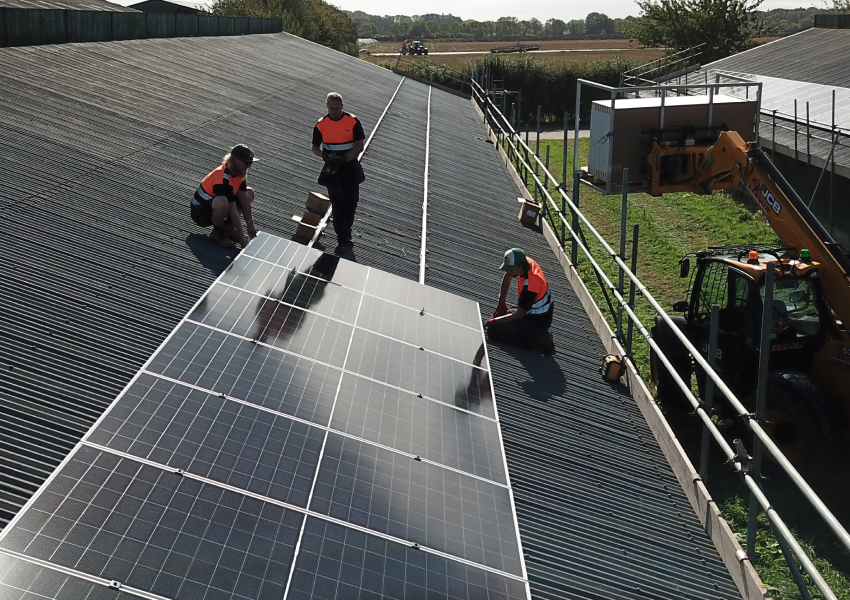
The sheds are timber-frame structures, which ruled out a standard multi-row layout. NerG designed a single row of panels, low down, in portrait orientation to maximise panel count without overloading the roof structure, a decision that also makes the array easier to clean. The finished system is a 116.25 kWp solar array paired with a 51 kWh Solax battery to cover night-time demand (lighting, feeders, fans), with full cabling and distribution board integration.
Working within poultry’s constraints
Because avian flu biosecurity governs everything on site, the installation had to run inside a tight window while the shed stood empty between flocks, roughly ten days. The aim was to finish inside it.
The result
Robert’s own decision rule is simple: anything under a 10-year payback “seriously needs a lot of consideration.” This project came in under that line. “It’s a no brainer really,” he says. “Too many people just sit around, and you’ve just got to get on with things.” The ambition now is just as clear: a farm that imports as little from the grid as possible. Once he’s seen how the whole system performs, Robert wants to look at getting more from the battery, including exporting at the right times of day.
“[NerG had] a very good grasp and understanding of what we needed,” Robert says. “They built a system around our requirements, rather than what they thought we needed.”

116.25 kWp - Array Size

51 kWh - Battery Size

92.5 MWh - Est. Annual Generation

60 kW - Inverter Capacity


