


From Fault to Fix
Investigating Ground Mount Solar
Published: October, 2025
It started, as many of our best jobs do, with a conversation at a trade show. One of our engineers was approached by a farmer near Market Rasen, who casually mentioned an ongoing issue with their solar setup, something that had already seen other providers come and go without resolution.
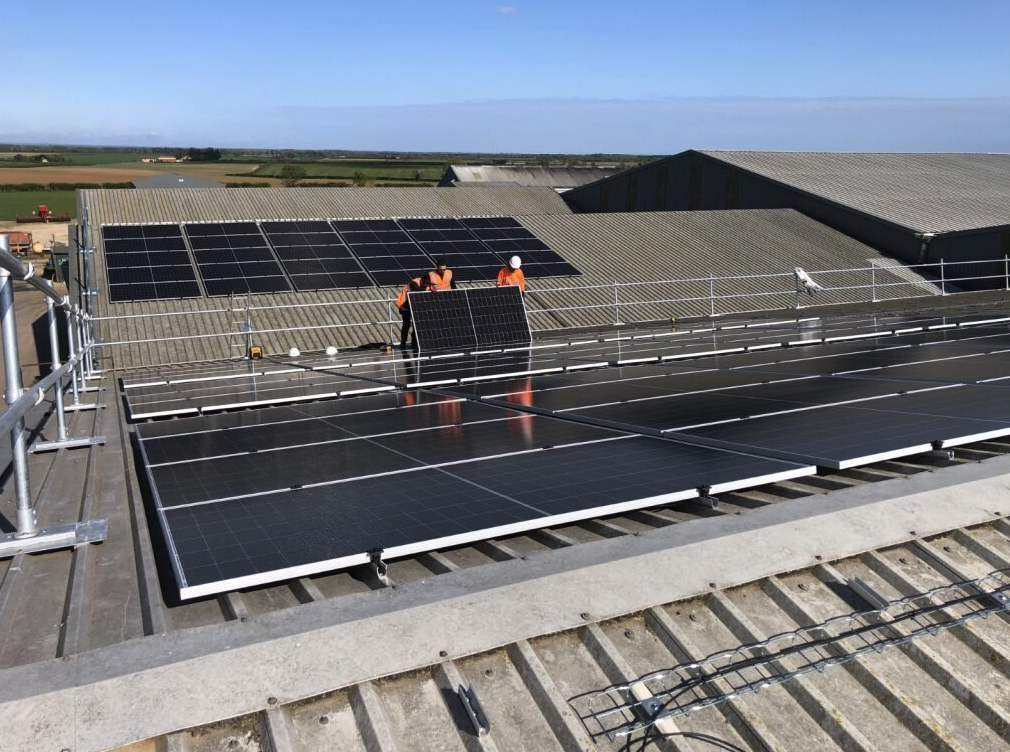
They weren’t a long-term customer of ours, but they knew of us through industry circles and existing relationships. They were running a mixed solar system: a combination of roof-mounted and ground-mounted PV arrays across the farm. What they really needed was clarity, someone who could take a fresh look and give them straight answers.
We booked a visit a few days after speaking.
Investigating the Ground Mount
The customer had noticed visible damage on some of the ground-mounted modules. They faced a paddock where heavy machinery often worked, and the modules had clearly taken a few knocks, cracked glass, visible corrosion, and evidence of debris damage.
While the damage looked concerning, appearances can be deceiving. We isolated and tested each string independently. The results? All strings were still operating normally, given the system’s age. The inverters weren’t being impacted by the damage, yet.
We advised the customer that the array was still performing as expected and outlined a simple plan for if and when individual modules do fail. The system had a mixture of parallel and single strings, so replacing or bypassing modules would be straightforward without affecting overall production.
Diagnosing the Roof-Mounted Fault
The roof system was a little more complex. Another company had already diagnosed a faulty inverter and replaced it, but the fault remained. That’s where we stepped in.
Of the three roof-mounted inverters, the first and third were performing normally. The second showed a fault: either no string detection or a ground fault.
We started from the basics, testing each string individually. Two of the three strings on that inverter had issues: one was an open circuit, and the other was showing a fault to ground. But one string was completely fine.
Oddly, when we connected the working string back to the inverter, the fault remained.
After a closer inspection of the DC isolator, we found the issue, miswiring. We’re not sure whether it occurred during the recent inverter replacement or earlier, but it was clear that the string wasn’t being correctly connected through the isolator.
Once rewired properly, the inverter immediately came online and started working with the single string. That brought 17% of the array’s production back instantly, seven of nine strings were now functional.
We’ve since advised the customer we can return with appropriate access equipment to trace and repair the two faulty strings. It’s often just a case of damaged connectors or worn cabling, nothing that can’t be resolved.
A Clear Path Forward
What started as an unresolved issue became an opportunity to recover solar performance and confidence. Within just a few days of that initial chat at an event, we’d been to the site, assessed the system, got as much working as we could and then provided a clear plan for rectifying the remaining issues.
Our focus is always to give honest, informed advice based on what we find, not just replace parts and hope for the best. And this job was no exception.
Whether it’s a long-standing client or a new introduction at an event, we approach every job the same way: investigate thoroughly, advise honestly, and work towards the most efficient fix.
Because when it comes to renewables, confidence matters as much as performance.
More News Articles
Diagnosing a Rooftop Solar Fault
Diagnosing a Rooftop Solar Fault One of our customers operating two sites near Newark contacted us with concerns about a …
What’s the ‘PV’ in Solar PV Energy?
What’s the ‘PV’ in Solar PV Energy? Solar PV, or solar photovoltaic, is the key to harnessing the sun’s power …


